

To identify the risks and opportunities for both Manchester City and the Premier League (PL), Flashscore's Paul Winters spoke with Berry van Drunen, a Netherlands-based sports lawyer.
Van Drunen is no stranger to high-profile cases, having led former Eredivisie side Vitesse's case against the Dutch football association, which revoked the club's professional licence. With the club facing extinction, Van Drunen and Vitesse won the preliminary injunction proceedings. Could a similar fate befall Manchester City, who face the mammoth task of overcoming 114 PSR charges?
This is the second part of a two-part interview series with Berry van Drunen. Part one focused on the general case, while part two focuses on Manchester City's defence.
Paul: With so many allegations, it looks as though they’ve done this knowingly and deliberately. This isn’t a mistake, is it?
Berry: "I often see this in the media, and I’ve experienced it myself (with Vitesse, ed.). People form their own opinions through the media, and I understand that, but for a lawyer like me, that's not how to handle this.
"First I look at the facts, then I consider the regulatory framework, and lastly the procedure. You can only get a clear view and ask yourself whether a sanction is appropriate (and, if so, what sanction) once you've worked through all of that.
"I’ve always been very surprised by all sorts of people who, in certain cases I’ve dealt with, have taken the liberty of talking at length about them as if they know what they're talking about.
"Cases like Man City's may run up to tens of thousands of pages. Yet everyone already has an opinion on the matter. I recognise this from certain cases I have dealt with, where everyone in the media already seemed to have decided what had happened.
"I have a problem with that, as it does not respect how the law works. If you don’t know all the details of a case file, you simply can’t make an informed decision - nor should you.
"At the same time, as a lawyer, I naturally think about potential legal arguments based on the publicly available information. In this respect, for example, the doctrine of good faith or the principle of legal certainty. Those are the first things that come to mind first. Can you keep bringing certain facts against a club indefinitely for the same offences, even across different jurisdictions?
"I think the PL is perfectly entitled to do so, as it is a different jurisdiction than UEFA (in the failed case in front of CAS, ed.), but it’s also an interesting angle for Manchester City to consider: Can that really be done without any restrictions? Is it always permissible? Is that actually reasonable?"
When the public already considers a club guilty, does that affect the club’s defence?
"Yes, certainly. What you mustn’t underestimate is the impact of public pressure. It’s intense - immense, in fact. When you find yourself in such a situation, it’s unlike anything you’ve ever experienced in any other case. And I’ve certainly handled other major cases, but this is unlike anything else because of the stakes involved - nobody wants to see their football club disappear.

"So what you see is that supporters, for example, start to get restless. The club struggles to sell season tickets for the following season. As a result, revenue comes under pressure.
"Sponsors are also less keen to commit to a club that may not exist for much longer. As a result, revenue comes under even further pressure. The greater the pressure becomes, the sooner various staff members, including players, jump ship.
"They don’t know if working or playing for the club will continue to work out, so they change paths. That dynamic may have serious consequences, because financial resources are becoming increasingly limited, and it means a great deal of knowledge and experience is draining out of the organisation.
"That alone can inevitably lead to bankruptcy. I find that quite drastic, and I don’t think that’s right either - such an outcome prior to independent legal proceedings in which the allegations that are made are being tested critically…
"As a lawyer, I don’t think that’s how the legal system should work. I don’t think that’s the right way to go about things - allegations can be drawn up rather easily, but should always be tested critically in accordance with fundamental legal principles by independent and impartial courts."
How can Man City mount a defence?
How would you, as the club's lawyer, put together a defence in cases like this, given what we know? From what angle would you attack it?
"If I were involved myself, the first thing I'd look at is both the facts that were established and the applicable rules. And in England, it’s very different. If you look at the professional football licensing regulations in the Netherlands, that’s a 14-page document.
"The licensing regulations in England are always much more detailed. That's typical of Anglo-Saxon law, which aims to cover every eventuality. Then you’re already talking about hundreds of pages.
"The applicable rules serve as a guideline for the assessment framework the PL has to apply. First, any involved lawyer should read through the entire file.
"Really plough through it from start to finish, and then things might start to stand out. A lawyer should also try to link the facts to the allegations or suspicions raised.
"Then you’ll try to reflect objectively and critically on that, asking yourself whether the allegations are really justified and whether they actually follow from the facts in every case, because it’s very easy to draw certain conclusions such as: 'They've been doing this completely wrong for years'.
"That may very well be a conclusion. Suppose it is; then you look into it. Does that pattern spanning years actually exist? If it does, have they, for example, already been punished for it? That has to do with the ne bis in idem principle, which makes it impossible to be punished twice for the same offence.

"I sometimes make the rather flimsy comparison to having children. If a parent punishes a child once for using a phone when they weren’t allowed to, and again a week later for the same offence, and again two weeks later, and again three weeks later, and then after four weeks the parent says: 'Yes, I can see a pattern now'.
"That’s obviously a contrived pattern. It’s something the parent is trying to create. You often see that sort of thing here.
"The moment people get the impression that 'what has happened is so intense and immense, this cannot be allowed and must have severe consequences', you often see the reporting being tailored to that. A certain eagerness to sanction seems to emerge. That is, however, not how the law should work.
"I find that worrying and incorrect, because this isn’t just a test for Manchester City itself and what Manchester City has done. What people seem to forget is that this case is as much a test for the regulator and how they will respond.
"And that’s exactly how it should be. Not everyone likes to hear that, especially if they already formed an opinion, but that’s precisely how the legal system is supposed to work.
"And so the question also arises: has the regulator actually built in reasonable safeguards? Have fundamental legal principles been observed? Has the club been able to respond to everything under the adversarial principle? Were the imposed timeframes reasonable?
"For example, and this is a thorn in my eye, the appeal period under the Dutch professional football licensing regulations is five working days. That applies to every ruling. There are many decisions where I can well imagine this is sufficient, as their impact is relatively limited.
"But imagine your licence is being revoked, or there is an intention to do so. Then you have to appeal against such a decision and the supporting documents, mostly consisting of hundreds, if not thousands or tens of thousands, of pages, within five working days.
"Bear in mind that the committee that came to such a decision, composed of legal and accountancy specialists, has been working on that very decision for months on end.
"I think, fundamentally, this is a disproportionate and unbalanced situation, which means that, from the outset, there is no due process. So a lawyer starts looking into that sort of thing. Fundamental legal principles: are they being upheld? Are you given the chance to defend yourself, or does the regulator apply a kind of tunnel vision very quickly, and seem to apply goal-oriented reasoning only?"
Is that where the difficulties lie for Manchester City and for the Premier League?
"Yes."
Manchester City, of course, also claim they are innocent...
"Yes, I read that too."
It makes sense, of course…
"I’m not sure about that. Because, as far as I’m concerned, if you’ve done something wrong, I think it’s more honourable to admit it openly. If you don’t, you make it a bigger issue in the legal proceedings and give the other party more ammunition if it turns out that you indeed did something wrong.
"Suppose you’re the judge and a lawyer tells you what seems to be the whole story, but leaves out this part because he thinks: 'Well, that doesn’t sit well with my client'. What do you think the other side will do? They’ll blow that part out of proportion and may well use it against you. And as a judge, you’ll think: 'Why didn’t you tell me that?'
"Suppose the lawyer has a fantastic story, and the judge thinks it’s a very good story, but if he’d known that, he may see things differently. And it is only human if a judge would feel that, apparently, this is a big issue since the lawyer didn’t want him to know this.
"So I believe, if mistakes have been made - which I can’t judge because I don't know the whole file, but suppose they have been - you should be honest about that. Obviously, these potential mistakes should also be put into the right context. And that ties back to what I just said: it mustn’t fit into the line of thinking that they’ve always done it wrong.
"You tend to see that with regulators every so often. If there are serious suspicions at all, they may think they see wrongdoing everywhere.
"That is exactly when any critical legal expert should wonder if you can actually see that alleged wrongdoing objectively. Or does the committee see it reflected because they simply believe a club is wrong, even if they aren't? Or is it perhaps far less serious than the committee's making it out to be?
"For example, failure to meet an imposed deadline in practice is obviously not good, but is that serious enough to say that someone is deliberately circumventing an entire system?
"Not automatically. Just imagine that you missed that deadline because, for example, you don’t have an accountant and you need one to meet the deadline. If that’s the situation, there’s nothing you can do about it. These are the sort of things where, if a club gets that criticism nonetheless, you think the reasoning isn’t entirely sound."
Part of the appeal could challenge the requirement that a ruling be issued shortly after the appeal is lodged. Realistically, do you think they can keep postponing a ruling indefinitely through clever appeals like this?
"The question naturally implies that you’re litigating strategically. That may be the case, but it doesn’t have to be. Nevertheless, the question is entirely valid in that sense.
"Ultimately, you can keep litigating for years on end. I think that's exactly what Manchester City is making very clear in their public statement: that they are willing to go the extra mile to fight the allegations. That makes it logical that a final ruling won’t come until much later.
"Any and all developments in the case also depend on the final ruling and what penalty the PL intends to impose. If it involves relegation to a lower division or even the club’s expulsion, then I can imagine the club would also have an interest in a swift ruling.
"And then, under English law - I’m no barrister, so I can’t assess this properly - there is the possibility of an interim judgment which is somewhat comparable to the Dutch preliminary injunction proceedings.
"That does give you the option of obtaining a provisional ruling. The only point is that any provisional ruling does not automatically mean the final judgment will be similar. In that sense, it seems justified to fight the case."
The fact that they want to drag out the proceedings, or at least want to keep fighting the case, and that they’re now saying they’re innocent… doesn’t that harm their case?
"Yes, but what alternative do they have? If they don’t do it, they’ll be found guilty anyway. Another factor is that the PL handles this very differently from how it’s done in the Netherlands. The PL has now been investigating for years. It was an eight-year period during which they conducted a seemingly intensive investigation, seemingly granting Manchester City the option to present its view on preliminary findings.
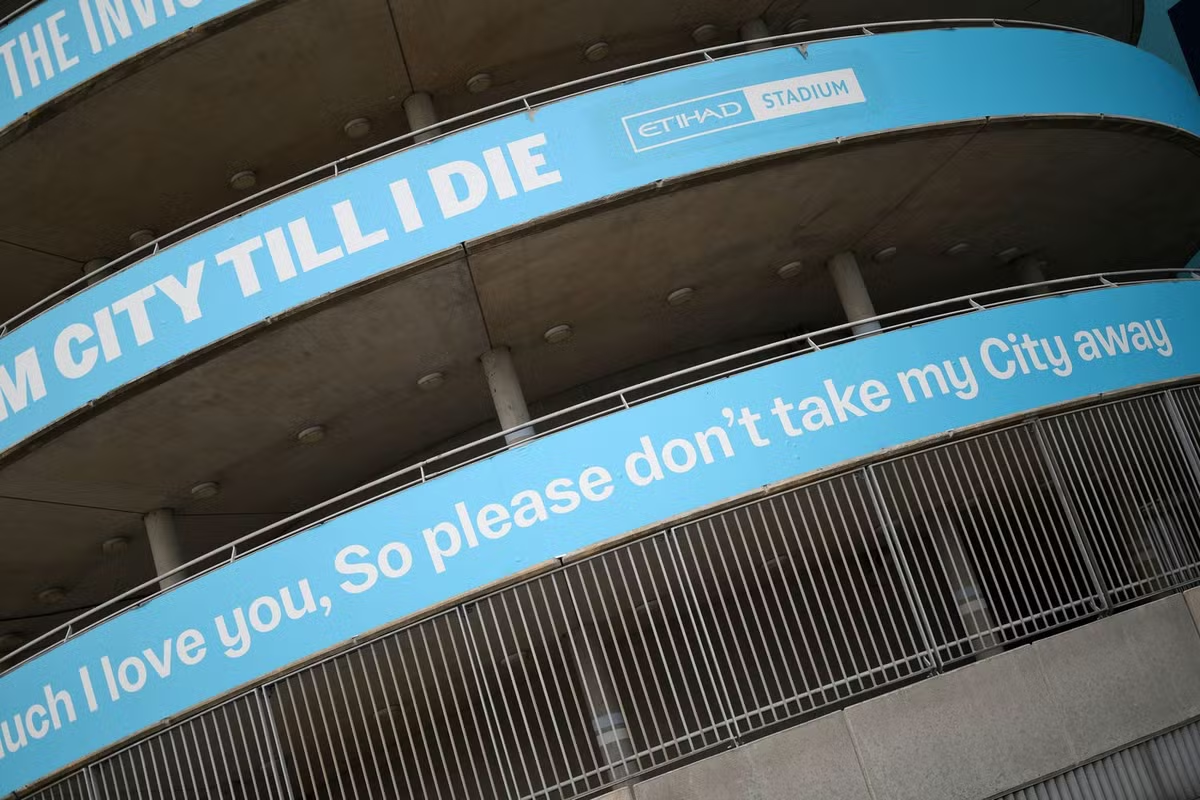
"That’s very different from how things are handled in certain other jurisdictions, such as the Netherlands. And they said: 'As far as we’re concerned, this has been proven, and you’re guilty of 114 out of the 115 charges'. But the sentence is still to be determined separately.
"That is fundamentally different from how things are done in the Netherlands, for example. You get a conclusion and sanction in one and the same ruling. There’s no similar phased decision-making.
"Because that's what it all boils down to: if you have a phased decision-making process, you naturally want to do everything you can - before a decision is made on the sanction - to first exhaust all appeal options against that finding of fact."
If City lose this case in the English courts, could they then take it to the CAS again?
"That’s an interesting question. Within the Dutch legal system, that would be possible. This is because the KNVB’s articles of association state very explicitly that you can always appeal to the CAS. But it all boils down to this: is that also the case in the Premier League’s articles of association?
"If I’m not mistaken, the situation is different within the PL, and they have opted exclusively for the British legal system. So if my understanding is correct, the club can appeal through the ordinary courts there, but not take the case to the CAS as well.
"CAS is arbitration. Arbitration is possible if the parties agree to submit their case to it. You can agree to this by including the option in your articles of association as a sports association and telling members: these statutes apply in full. As a member, you accept that. Then that constitutes an agreement, and you can go to CAS. The parties can agree to go to CAS in a separate agreement between them as well."
For City, does it make any difference whether you go to the CAS because of the substance of the ruling or because of the committee? Could they ask the CAS: Is this committee truly independent? Was this handled correctly?
"If I were Manchester City, I’d definitely want to go to the CAS, knowing that back in 2020 they’d already said, regarding seemingly similar allegations, that there wasn't enough evidence to substantiate these. But if you’re the PL, you’d most likely not want that. So, insofar as that hasn’t already been agreed, I don’t expect the PL to cooperate easily. It simply doesn’t seem to be in their interests."
Does the club have a case to make simply because one of those 115 charges was dismissed?
"I can’t say if they do. Generally speaking: If one of the 115 charges is found to be unfounded but the other 114 are upheld, you still have a massive problem."
As the club's legal adviser, one thing would be clear to you: The club claims innocence, so we treat them as innocent, right?
"You’re referring to the presumption of innocence. The PL will claim this isn’t criminal law, but it’s an important point to raise, because that regulatory body often acts, in effect, like the Crown Prosecution Service.
"Whether that’s the professional football licensing committee in the Netherlands or this committee at the PL. In criminal law, suspects have additional, more stringent safeguards. I wonder whether those additional safeguards have been fully incorporated into the current professional football system.
"I don’t think so, but I feel it would make sense to have these if clubs are increasingly being held accountable under financial criminal law - or at least regulations that are based on financial criminal law.
"Another relevant factor to consider in this respect is of a more political nature. Professional football is, in some respects, very opportunistic.
"On the one hand, the PL wants to be the best. And for the best league, you mostly need the highest-paid footballers. That requires a lot of money. If people are willing to pay that kind of money, they are welcomed with open arms - whether it’s Ryan Reynolds, the Glazers, Saudi Arabia, or investors from the Emirates. Everyone wants to invest because the PL is a fantastic showcase.
"On the other hand, the PL is now very strict about the fact that all clubs should comply with the increasingly strict league rules. That’s how it should be, if only to create a level playing field internationally.
"But perhaps we also need to engage in some critical self-reflection as a society and look at the bigger picture. Is it really healthy that we’re moving towards ever-higher salaries for footballers, higher ticket prices for fans and more media revenues for the clubs? Or should we bring the economics of professional football back to a more normal level, accepting a regular economic climate?
"If we normalise things in that regard, these kinds of excesses are likely to occur less frequently. But if we don't, I wouldn't be surprised if we see many more cases like Manchester City in the coming years."